






Gráfica rápida: AI and Print Through the Five Stages of Grief

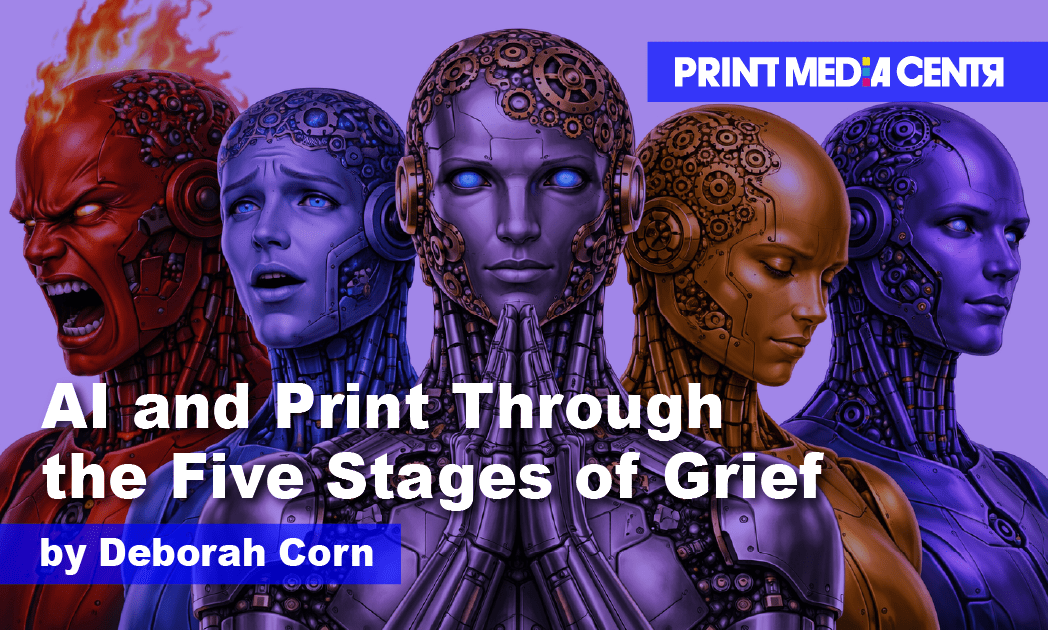

AI and print are beginning to explore a new working relationship. Artificial intelligence may not be flooding production floors yet, but it is reshaping how art is created before print ever enters the picture. New technology brings new challenges, especially when tools can generate artwork and files that appear ready for production.
The five stages of grief is a framework for understanding how people respond to change. It shows how uncertainty triggers resistance, pressure produces frustration, and progress begins once people recognize what is actually happening.
Let’s look at AI and print through the five stages of grief.

“AI art creation is a fad.”
Every disruption is labeled this way at first.
It is easier to believe customers are experimenting than to admit a fundamental shift in how art is being created.
But expectations are forming.
Calling AI art generation temporary does not slow adoption. It only delays print’s involvement while the rules change.
The longer denial lasts, the further influence drifts away from the people who understand how the work performs in the real world.

“Why are we seeing this AI-generated art so late?”
Files arrive after creative decisions are made, and printing success is already defined.
Problems are obvious, many were preventable, and our collaborative influence is gone.
It is frustrating to inherit risk without having an opportunity to manage and/or avoid it.
And the frustration is understandable, but it does not restore a seat at the table.

“We’ll make it work.”
Printers protect customer relationships by absorbing pain.
They rebuild files, correct mistakes, and negotiate compromises.
Margins tighten. Schedules shrink.
Customers carry on without any pushback.
The job ships, and the costs are absorbed under the ‘price of doing business’.
Rescuing the work may save the moment, but it quietly reinforces a cycle where expertise arrives too late to matter.

“We are not being treated like experts.”
Not because AI exists, but because printers are brought in after the art is created.
Experience that once influenced outcomes is now spent on AI and print damage control.
Collaborative customer relationships can quickly slide back into transactions.
When that happens, value becomes measured by output, not insight.

AI begins the process. Print expertise determines the outcome.
Acceptance is not surrender. It is repositioning.
Customers are moving faster and exploring more ideas in more places.
They need partners who understand how those ideas perform in reality and who can guide AI and print decisions before they become expensive.
This is where printers shift from reacting to problems to shaping success.
Where Opportunity Opens
Printers who quickly reach acceptance that AI art is here to stay can maintain or regain influence with customers. They can help prevent mistakes, protect budgets, and strengthen campaigns before they are underway.
Printers should not be obstacles to creativity. They can enable and champion print possibilities once they have accepted that AI-generated files will start showing up, and learn best practices for handling them from pre-press to printing.
If AI is where work begins, printers have an opportunity to shape how it is built.
That means stepping forward earlier, sharing expertise sooner, and helping customers understand how digital ideas translate to physical outcomes.
When that happens, collaboration begins before art creation, success becomes repeatable, and customer loyalty is locked in for the long-term.
Printers who lead this shift with customers will not be reacting to the future.
They will help design it.
##
See Deborah’s recent post: Customer Collaboration Transforms Printers into Creative Hubs
See all posts by Deborah

Deborah Corn is the Intergalactic Ambassador to the Printerverse at Print Media Centr and Executive Director of Girls Who Print, the largest global professional network for women in print and graphic communications. She is a Print Buyerologist, international speaker, content creator, industry advocate, and host of Podcasts From The Printerverse.
She founded Project Peacock, International Print Day, and PrintFM Radio, the industry’s first 24/7 global radio station, creating platforms that connect brands, printers, suppliers, and students worldwide. Deborah also leads the Print Production Professionals Group, the largest print community on LinkedIn. Through her media, events, and education initiatives, Deborah helps companies of all sizes reach qualified audiences, build visibility, and create meaningful engagement with print and marketing professionals.
She is a recipient of multiple industry honors and serves on advisory boards and technical committees supporting print education and career development.
Connect with Deborah on LinkedIn
Please subscribe to PMC’s News from The Printerverse for monthly printspiration delivered to your inbox.
Precisa de impressão rápida e profissional?
Conheça nossa
gráfica rápida Sertãozinho/SP
com soluções em cartões de visita, panfletos, banners e muito mais.
Categorias